
Flying at full speed: the 10 fastest birds of Cadiz
The province of Cadiz, with its diverse landscapes ranging from coastal cliffs and wetlands to mountain ranges and open fields, is home to a rich variety of bird species. Many of these birds are known for their agility and speed, whether in the air or during hunting dives. In this blog post, we explore the ten fastest birds that can be found in Cadiz, either as residents or during their migration, along with their top speeds.
10. Eurasian Goshawk (Accipiter gentilis) – 110 km/h
More elusive than most other raptors in Cadiz, the Eurasian Goshawk inhabits forests in the province and is an expert ambush predator. It can accelerate quickly to 110 km/h while pursuing prey through dense woodland, using its short, broad wings and long tail to navigate through trees with remarkable agility. In Cadiz, it is mainly found in wooded areas of the Sierra de Grazalema and Los Alcornocales Natural Park.

9. Common Swift (Apus apus) – 111 km/h
A summer visitor to Cadiz, the common swift is one of the fastest birds in level flight, reaching speeds of up to 111 km/h. These aerial masters spend almost their entire lives in the air, feeding on insects and even sleeping while flying. Swifts can be seen screaming through the skies of Cadiz city, Jerez de la Frontera, and many smaller towns during warm summer evenings.

8. Osprey (Pandion haliaetus) – 120 km/h
A winter visitor and passage migrant, the Osprey is a fish-eating raptor that can be seen along the coast, marshes, and rivers of Cadiz. It reaches speeds of 120 km/h when diving into the water to snatch fish with its powerful talons. In the province, Ospreys are regularly spotted at the Barbate marshes, the Guadalquivir estuary, and occasionally at reservoirs inland.

7. Red Kite (Milvus milvus) – 120 km/h
A winter visitor and passage migrant in Cadiz, the Red Kite is known for its effortless gliding and sudden bursts of speed, reaching up to 120 km/h. This raptor is easily recognizable by its forked tail and elegant, slow-flapping flight. Large numbers can often be seen in the agricultural fields of La Janda during the colder months.

6. Montagu’s Harrier (Circus pygargus) – 130 km/h
Montagu’s Harrier is a summer breeder in Cadiz, favoring open fields and grasslands. It can reach speeds of 130 km/h while hunting, using its agile flight to maneuver through vegetation in search of small mammals, reptiles, and insects. In the province, this graceful raptor is closely associated with the La Janda plain and surrounding farmland.

5. Rock Pigeon (Columba livia) – 148 km/h
The Rock Pigeon is one of the fastest birds in level flight, reaching speeds of up to 148 km/h. Pigeons are common throughout the province, especially in urban areas, farmland, and cliffs. They are particularly numerous in Cadiz city walls, around Tarifa, and nesting on cliffs near Vejer de la Frontera.

4. Eleonora’s Falcon (Falco eleonorae) – 160 km/h
Although mainly breeding on Mediterranean islands, Eleonora’s Falcon passes through Cadiz during migration. It is known for its incredible speed of up to 160 km/h when chasing down small birds over open water or coastal cliffs. The Strait of Gibraltar is one of the best places to witness this falcon during late summer and early autumn migration.

3. Booted Eagle (Hieraaetus pennatus) – 160 km/h
The Booted Eagle is a medium-sized raptor that breeds in Cadiz and can be found in forests, hills, and coastal areas. It can reach speeds of around 160 km/h when diving to catch its prey, which includes birds, small mammals, and reptiles. It is frequently seen soaring above the Sierra de Grazalema and Los Alcornocales Natural Park.

2. Eurasian Hobby (Falco subbuteo) – 160 km/h
The Eurasian hobby is a sleek and agile falcon that passes through Cadiz during migration. It is capable of reaching speeds of 160 km/h, making it a formidable hunter of swallows, swifts, and large insects like dragonflies. In Cadiz, it is most often seen over the open countryside of La Janda during migration periods.

What is the fastest bird in Cadiz?
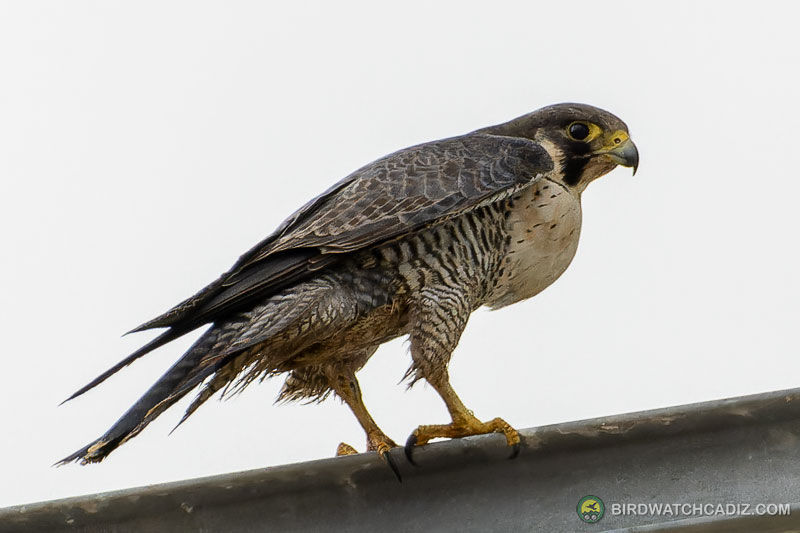
1. Peregrine Falcon (Falco peregrinus) – 389 km/h
The Peregrine Falcon holds the title of the fastest bird in the world, and it can be spotted in Cadiz both as a resident and a migratory species. In the province it often nests on coastal cliffs such as those near Tarifa and Barbate, on rocky outcrops in the Sierra de Grazalema, and occasionally even on tall buildings. This formidable raptor is famous for its high-speed hunting dives, known as stoops, where it can reach speeds of up to 389 km/h.
Theoretical vs. real-world speeds
It is important to note that the speeds listed above are theoretical maximums recorded under ideal conditions. In reality, a bird's actual speed can vary based on factors such as wind resistance, weather conditions, and flight purpose. While some species may reach their top speeds in specific scenarios, such as hunting or escaping predators, their average flight speeds are usually lower during normal movement. Nonetheless, these birds remain some of the fastest fliers in the avian world.
Why speed matters for birds
Speed plays a crucial role in a bird’s survival strategy. Raptors like falcons and eagles rely on high velocity to overtake or ambush agile prey, while swifts need speed to catch insects in mid-air. For migratory species, sustained fast flight helps cover thousands of kilometers during seasonal journeys. On the other hand, many birds are not built for speed but for endurance, stealth, or manoeuvrability. Herons, storks, and many songbirds fly at slower paces because their survival depends more on energy efficiency, camouflage, or agility in dense vegetation rather than outright speed. In short, each bird has evolved a flight style that perfectly matches its ecological niche.
FAQ
When is the best time to see fast birds in Cadiz?
Spring and autumn are the best times, as migration funnels thousands of raptors and swifts through the Strait of Gibraltar. Summer is excellent for swifts and Montagu’s Harriers, while in winter there are Red Kites.
Where can I go birdwatching in Cadiz to see these species?
Top sites include the La Janda agricultural plain, the Barbate marshes, the Sierra de Grazalema, and coastal cliffs near Tarifa and Bolonia. These locations offer some of the best chances to witness high-speed raptors and aerial insect hunters.
Are these birds easy to spot for beginners?
Some, like Rock Pigeons and swifts, are abundant and easy to observe. Others, such as Peregrine Falcons or Goshawks, require patience and local knowledge but are rewarding sightings for birdwatchers.
Conclusion
If you spend any time watching birds in Cádiz, it quickly becomes clear why this province is so special. Few places in Europe let you watch swifts tearing through city skies, harriers skimming fields, and peregrine falcons cutting across cliffs — sometimes all in the same day. Speed here isn’t an abstract number; it’s something you can actually see and feel when a falcon flashes past or a flock of swifts screams overhead at dusk.
What makes birdwatching in Cádiz so rewarding is that these fast birds are part of everyday landscapes, not hidden away in remote reserves. From farmland and wetlands to mountains and coastal cliffs, the province offers endless chances to slow down, look up, and notice just how finely tuned these birds are to their environment. Once you start paying attention, the skies of Cádiz never feel empty again.


Comments