
Looking for a lifer around the lagoons of Los Palacios
- Feb 27
- 5 min read
After a rather cold and exceptionally wet winter, spring is finally knocking on the door here in southern Spain. Or perhaps I should say: it is knocking briefly before giving way to something that already feels like early summer. In Andalucía, the transition between seasons is often abrupt. We barely get a spring or an autumn — one day you are wrapped in layers against the damp cold, and the next you are walking in short sleeves under a blazing sun.
That was exactly the feeling I had during today's trip to the lagoons of Los Palacios y Villafranca, a town in the province of Seville. My original plan had been to explore several lagoons in the province of Cádiz, but temptation got the better of me. Reports had been circulating about a species that would have been a lifer for me: the Laughing Dove, frequently seen around the lagoons of Villafranca, particularly near Laguna El Pantano. How could I resist? My first stop was Laguna El Pantano. The air was warm, the sky cloudless — a dramatic contrast with the grey, rain-soaked weeks behind us. The landscape shimmered under the sun, and for a moment it was easy to forget how saturated everything had been not long ago.


As I stepped out of the car, I was welcomed by the unmistakable call of a Hoopoe. Its soft, bubbling notes carried across the lagoon — a sure sign that spring is near. Though I searched carefully, I never managed to see the bird. Still, hearing it felt symbolic: a seasonal turning point.
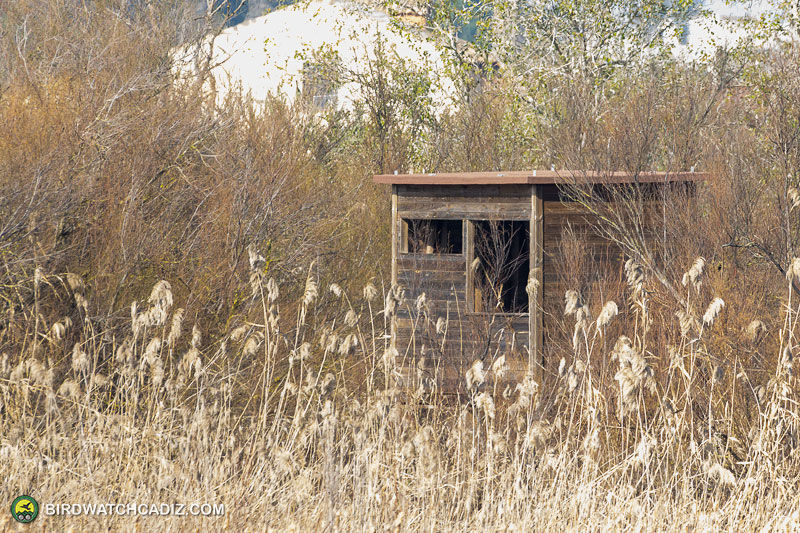
El Pantano has a hide, but as I approached it, I quickly realized it would not be of much use. The vegetation was incredibly dense. Reeds dominated the landscape; water seemed almost secondary. Even after weeks of abundant rainfall, there were only a few visible patches of open water.

Instead of entering the hide, I chose to walk along the opposite side of the lagoon. Despite the scarcity of visible water, birdlife was abundant. The highlight here was undoubtedly a pair of Purple Heron, elegant and alert among the reeds. Their slender necks and reddish tones stood out beautifully against the vegetation.


Groups of Glossy Ibis moved through the shallows, their dark plumage gleaming with iridescent hints in the sunlight. Several Great Cormorant were resting nearby, drying their wings.


At one point, a singing Bluethroat caught my full attention. The song was clear and melodious, impossible to ignore. I stood still, scanning the reeds, hoping for a glimpse of this precious little bird. But as is often the case with Bluethroats, it remained hidden, offering only its voice as consolation.

And what about my target species? The Laughing Dove — a bird native to Africa, increasingly recorded in this area — remained elusive. No lifer today. Still, recording over forty different species at this single location made the visit more than worthwhile.

Laguna La Mejorada – grebes and patience
My second stop was Laguna La Mejorada, and immediately I was greeted by an impressive sight: a large colony of Western Cattle Egret roosting in the trees. There must have been at least a hundred individuals, perhaps more. I could only imagine how spectacular the scene would be later in the evening when even more birds return to their communal roost.


On the water’s surface, hundreds of gulls rested peacefully. Among them were numerous Black-headed Gull and Yellow-legged Gull. Their white and grey bodies shimmered under the sun, creating a bright contrast against the darker water.

But the true highlight of La Mejorada was the presence of several pairs of Great Crested Grebe. When I first arrived, I noticed a pair swimming away from the shore, perhaps slightly disturbed by my presence despite my careful steps. Determined to observe them more closely, I lay down on the grass and waited patiently. Birding often rewards patience — and this was certainly one of those moments.


The grebes tended to swim between dense vegetation, disappearing from sight only to resurface fifty meters further away. It required focus and anticipation. Eventually, a pair emerged close enough for me to take some satisfying photos. To my surprise, I later realized this was not the same pair I had initially seen — meaning there were at least three pairs present in the lagoon!

One particularly magical moment occurred when I watched a pair approach each other slowly, their necks stretched forward, almost touching — as if they were kissing. It was an intimate glimpse into their courtship behaviour, subtle and beautiful.


Even more surprising was the sight of a family group with two juveniles. It felt early in the season for young birds already to be present. I found myself wondering just how early these grebes had started breeding this year. The mild winter perhaps? Climate patterns shifting? Observations like this inevitably lead to bigger questions.

While walking along the path, I suddenly heard a distant, trumpeting call. Looking up, I spotted about twenty Common Crane flying overhead. They were accompanied by a flock of White Stork, both species moving gracefully across the vast Andalusian sky. A spectacular sight.


Cerro de las Cigüeñas – a relaxing finale
My final stop was Cerro de las Cigüeñas — literally “Hill of the Storks.” The name is fitting. White Stork were everywhere: flying overhead, standing in nearby fields, perched on structures.


What impressed me most here was the sheer number of Common Moorhen. I counted over forty individuals moving along the edges of the lagoon, their red bills vivid against their dark plumage.
There is a well-positioned hide at this lagoon offering a wide and calming view over the water. It is the kind of place where one can easily spend hours, simply observing and letting time slow down. After a full day of walking and scanning, this felt like the perfect, peaceful ending.


Reflections on a changing season
Walking back to the car in short sleeves under a sun that felt more like June than early spring, I couldn’t help but feel both joy and concern. The speed with which the seasons shift in southern Spain is astonishing. Winter can feel persistent and cold — until suddenly it vanishes. But if it already feels this warm now, what extremes might the coming summer bring?
Still, worries aside, this was a deeply satisfying day in the field. Although I did not manage to spot the Laughing Dove — my hoped-for lifer — I recorded more than forty species at El Pantano alone and enjoyed unforgettable encounters at every stop.

Birding teaches patience. It teaches acceptance. Sometimes the target species does not appear, but the experience itself — the light, the sounds, the unexpected moments — becomes the real reward.
And who knows? The Laughing Dove is still out there. Perhaps next time.


Comments