
Ringing birds at dusk in the Mesas de Asta wetlands
Updated: Jul 22, 2025
As evening light gently bathed the Mesas de Asta wetlands (Jerez de la Frontera), the stage was set for an activity that combined precision with excitement: bird ringing. I joined a group of volunteers—including members of the SGHN Limes project—alongside technicians and birding enthusiasts, all brought together by a shared interest in this vital conservation work.


The meeting point was an area known as Haza de la Torre. I had the opportunity to speak with José Cabral, a technical specialist in biodiversity, who explained more about the activity, the ecological value of the area, and the species that we banded.

We focused on two threatened species: the Slender-billed Gull (Chroicocephalus genei) and the Gull-billed Tern (Gelochelidon nilotica). Bird ringing provides essential data for their conservation. As José explained, the frequency of monitoring varies according to the species’ conservation status. Some, like the critically endangered Northern Bald Ibis, are tracked annually. Others that also require close attention include the White-headed Duck, Marbled Duck, and Red-knobbed Coot.
But it's also essential to closely monitor less endangered species to detect any signs of decline early and prevent them from reaching critical situations. That's why initiatives like this are so important.


The place where we worked is home to one of the largest breeding colonies of Slender-billed Gulls in Europe, and the largest in all of Spain. In dry years, when suitable habitats are scarce, these birds gather here because water is always available. Up to a thousand pairs of Gull-billed Terns also come together here, creating a true natural spectacle.

One of the things that stood out to me was how many of the chicks we captured showed signs of weakness—some had an infected eye or visible malformations. José explained that this is completely normal. Because we ring at the end of the breeding season to minimize disturbance to the birds, the strongest individuals have usually already left the nest. The ones still present are mostly the offspring of first-time or less experienced parents, and these chicks are more likely to be affected by parasites.

This year has been especially remarkable due to what José described as a “reproductive explosion” in certain parts of the Mediterranean. In dry years, breeding activity drops significantly. But in wetter years like this one, it can multiply by up to a hundred times. These are natural cycles that have occurred historically. While the effects of climate change are undoubtedly present, there is still not enough long-term data in this specific region to fully assess its impact. Monitoring efforts began in the 1960s, and the most noticeable effects so far have been observed in places like the Sierra Nevada, where the contrast between dry and wet years has become increasingly pronounced.

During a previous visit to watch birds in Mesas de Asta, I remember seeing the water level much higher. José explained that the water level is regulated by floodgates. In the past, the wastewater from the sugar industry arrived here. After the site was abandoned, a restoration process began that has transformed the former artificial lagoons into an ecosystem with a remarkable wealth of fauna. Today, these lagoons are fed solely by rainwater and are connected to other nearby wetlands, forming an interdependent system vital to many species.

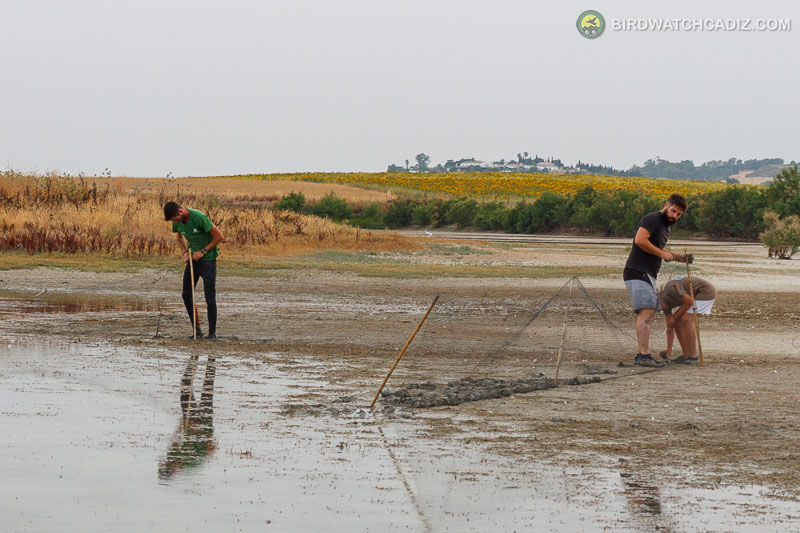
The birds were captured with care and efficiency. We located the juveniles gathered in groups—some floating in shallow water, others resting on small islands within the wetland. From there, we gently guided them toward the nets we had set up in advance, where we were able to catch as many as possible to proceed with the banding process.


What surprised me most was the birds' calmness throughout the entire process. For most of them, it was the first time they'd seen a human being... but it certainly won't be the last.


Comments